Strengthening Industrial Output With Smarter Maintenance
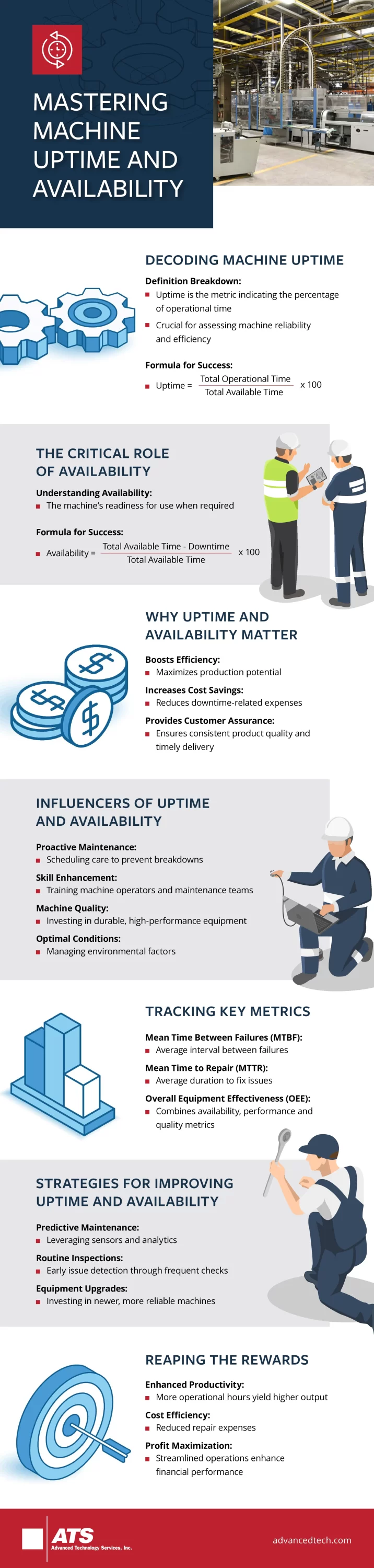
To keep production lines moving and orders fulfilled on time, manufacturers rely on a consistent standard of performance from their equipment. This is why machine uptime and availability are considered foundational metrics in operational management. Optimizing them leads to more throughput, reduced operating costs, and better resource planning.
Machine uptime reflects how long a piece of equipment operates without failure. Availability encompasses not only uptime but also the readiness of that equipment to perform when needed. Machines can be offline due to reasons unrelated to failure, such as tool changeovers or staffing gaps—making availability a more holistic measure of productivity.
Maintenance strategies play a central role in driving both uptime and availability. Preventive maintenance involves scheduling regular service activities to reduce the likelihood of sudden failures. Predictive maintenance goes a step further by using data to forecast issues based on equipment behavior. Both strategies aim to keep machines running while minimizing unplanned interventions.
But these strategies can falter if the necessary MRO parts aren’t immediately available. Whether it’s a replacement valve, sensor, or fastener, downtime is often extended simply because the right part isn’t in stock. Having a well-managed inventory of MRO parts allows maintenance teams to act quickly and efficiently, reducing both repair times and associated labor costs.
In addition to robust maintenance and inventory systems, having knowledgeable technicians is essential. Properly trained personnel are able to recognize early signs of malfunction, ensuring swift and effective repairs. Coupled with digital maintenance records and part-tracking software, they form a responsive and agile team that can prevent extended equipment outages.
Environmental conditions—like humidity, dust, or heat—can accelerate machine degradation. Investing in proper enclosures, air filtration, and consistent temperature control will reduce the wear on both machines and the MRO parts used to service them.
With metrics like MTBF and MTTR guiding performance evaluations, businesses can fine-tune their maintenance approaches. These indicators help identify patterns, making it easier to predict when machines will need attention and allowing for better planning of part replenishment.
Improving uptime and availability isn’t just about avoiding breakdowns—it’s about building a resilient system. Ensuring access to critical MRO parts is a key part of that system, enabling teams to keep operations running and outputs consistent.